Machine Learning With Python Training in Hyderabad
Learn machine learning with Python — NumPy, Pandas, supervised and unsupervised learning, deep learning, NLP and MLOps — working on 50 datasets and two domain-specific live projects.
G4.7★★★★★on Google 5000+ students trained- Duration
- 45 Days
- Mode
- Online & Classroom
- Batches
- Weekday & Weekend
- Hands-on
- 2 domain live projects
Quick Enquiry
Get a free demo session today!

ML | What is Machine Learning?
Arthur Samuel, a pioneer in the field of artificial intelligence and computer gaming, coined the term "Machine Learning". He defined machine learning as – "Field of study that gives computers the capability to learn without being explicitly programmed".
- Interview support & resume preparation
- Interview referrals until you get placed
- Real-time job support after you join a company
Course highlights
- 50 datasetsPractise on 50 datasets across the course.
- 2 domain-specific live projectsPlus Q&A and placement assistance.
- Classic ML to deep learningFrom regression and clustering to CNNs, NLP and generative models.
- Deployment and MLOpsServe models with Flask or FastAPI and track experiments with MLflow.
Skills you’ll learn
In a very layman manner, Machine Learning (ML) can be explained as automating and improving the learning process of computers based on their experiences without being actually programmed i.e. without any human assistance. The process starts with feeding good quality data and then training our machines (computers) by building machine learning models using the data and different algorithms. The choice of algorithms depends on what type of data do we have and what kind of task we are trying to automate.
Introduction To Machine Learning
Machine learning is a type of artificial intelligence (AI) that provides computers with the ability to learn without being explicitly programmed. Machine learning focuses on the development of Computer Programs that can change when exposed to new data.
Best Python Libraries for Machine Learning
Machine Learning, as the name suggests, is the science of programming a computer by which they are able to learn from different kinds of data. A more general definition given by Arthur Samuel is — "Machine Learning is the field of study that gives computers the ability to learn without being explicitly programmed." They are typically used to solve various types of life problems.
In the older days, people used to perform Machine Learning tasks by manually coding all the algorithms and mathematical and statistical formula. This made the process time consuming, tedious and inefficient. But in the modern days, it has become very much easy and efficient compared to the olden days by various python libraries, frameworks, and modules. Today, Python is one of the most popular programming languages for this task. Python libraries used in Machine Learning are:
- Numpy
- Scipy
- Scikit-learn
- Theano
- TensorFlow
- Keras
- PyTorch
- Pandas
- Matplotlib
Course Curriculum
- Data Types, Variables, and Operators
- Control Flow: if, else, for, while loops
- Functions and Lambda Expressions
- Exception Handling
- File Handling and I/O Operations
- Object-Oriented Programming (OOP) in Python
- Decorators, Iterators, and Generators
- Context Managers
- Python Modules and Packages
- Working with Dates and Times in Python
- Lists, Tuples, Sets, and Dictionaries
- Stacks, Queues, Linked Lists, Trees, and Graphs
- Searching and Sorting Algorithms
- Recursion and Dynamic Programming
- Algorithm Complexity: Big-O Notation
- Creating and Manipulating Arrays
- Broadcasting and Vectorized Operations
- Mathematical and Statistical Functions
- Working with Multi-dimensional Arrays
- Advanced Array Operations
- Series and DataFrame Objects
- Data Cleaning and Preparation
- Handling Missing Data
- Merging, Joining, and Concatenating DataFrames
- Grouping and Aggregating Data
- Creating Plots and Charts with Matplotlib
- Customizing Plots: Titles, Labels, Legends
- Advanced Plots: Heatmaps, Pair Plots, and Facet Grids
- Interactive Visualizations with Plotly
- Data Visualization Best Practices
- Overview of Machine Learning: Supervised, Unsupervised, Reinforcement Learning
- Bias-Variance Tradeoff
- Evaluation Metrics: Accuracy, Precision, Recall, F1-Score, ROC-AUC
- Cross-Validation and Model Selection
- Data Preprocessing: Feature Scaling, Encoding, Normalization
- Linear Regression: Simple and Multiple Linear Regression, Regularization Techniques: Lasso, Ridge, ElasticNet, Polynomial Regression, Evaluating Regression Models
- Classification Algorithms: Logistic Regression, k-Nearest Neighbors (k-NN), Support Vector Machines (SVM), Decision Trees and Random Forests, Naive Bayes Classifier
- Ensemble Methods: Bagging and Boosting Techniques, Gradient Boosting Machines (GBM), XGBoost, LightGBM, and CatBoost, Stacking and Blending Models
- Clustering Algorithms: k-Means Clustering, Hierarchical Clustering, DBSCAN (Density-Based Spatial Clustering), Gaussian Mixture Models (GMM)
- Dimensionality Reduction: Principal Component Analysis (PCA), Linear Discriminant Analysis (LDA), t-SNE and UMAP, Feature Selection and Extraction Techniques
- Anomaly Detection: Statistical Methods for Anomaly Detection, Isolation Forest, Autoencoders for Anomaly Detection, Applications of Anomaly Detection
- Basics of Reinforcement Learning
- Markov Decision Processes (MDPs)
- Q-Learning and Deep Q-Networks (DQNs)
- Policy Gradient Methods
- Applications of Reinforcement Learning in Industry
- Basics of Neural Networks and Perceptrons
- Activation Functions: ReLU, Sigmoid, Tanh
- Forward and Backward Propagation
- Loss Functions and Optimization: Gradient Descent, Adam
- Overfitting and Regularization: Dropout, Batch Normalization
- TensorFlow 2.x: Building and Training Models with Keras API, Customizing Models and Layers, Handling Large Datasets with tf.data, Model Deployment with TensorFlow Serving
- PyTorch: Building and Training Models in PyTorch, Autograd and Dynamic Computation Graphs, Transfer Learning with Pre-trained Models, Implementing Custom Loss Functions and Layers
- Advanced CNN Architectures: Convolutional Neural Networks (CNNs) Basics, Advanced Architectures: ResNet, Inception, EfficientNet, Object Detection with YOLO and SSD, Image Segmentation with U-Net and Mask R-CNN, Practical Applications: Computer Vision Projects
- Text Preprocessing: Tokenization, Stemming, Lemmatization
- Word Embeddings: Word2Vec, GloVe, FastText
- Sequence Models: Recurrent Neural Networks (RNNs), LSTMs, GRUs
- Attention Mechanism and Transformers
- Advanced NLP with BERT, GPT, and T5
- Sentiment Analysis, Text Classification, and Machine Translation
- Variational Autoencoders (VAEs)
- Generative Adversarial Networks (GANs): Conditional GANs, CycleGANs, Image Synthesis and Style Transfer
- Applications of Generative Models
- Building RESTful APIs for Model Serving
- Deploying Models with Flask, FastAPI
- Model Deployment on AWS, Azure, GCP
- Containerization with Docker for Model Deployment
- Scaling Models in Production
- Continuous Integration/Continuous Deployment (CI/CD) for ML
- Model Monitoring and Performance Tracking
- Automating Model Retraining Pipelines
- Data Versioning and Experiment Tracking with MLflow
- End-to-End MLOps Platforms: Kubeflow, TFX
- ARIMA, SARIMA Models
- LSTM for Time Series Forecasting
- Prophet for Time Series Analysis
- Advanced Forecasting Techniques
- Collaborative Filtering and Matrix Factorization
- Content-Based Filtering
- Hybrid Recommender Systems
- Deep Learning for Recommender Systems
- Face Recognition and Emotion Detection
- Autonomous Vehicles: Object Detection and Lane Detection
- Medical Imaging: Disease Detection and Diagnosis
- Bias and Fairness in Machine Learning Models
- Explainability and Interpretability of Models
- Ethical Considerations in AI Deployment
- Regulatory Compliance and Governance
- Data Collection, Cleaning, and Preprocessing
- Model Building, Tuning, and Evaluation
- Model Deployment and Monitoring in Production
- Documentation and Reporting of the Project
- Finance: Fraud Detection, Stock Price Prediction
- Healthcare: Predictive Modeling, Personalized Medicine
- Retail: Customer Segmentation, Demand Forecasting
- Social Media: Sentiment Analysis, Trend Prediction
Overview — Data Science, ML & AI
Data science is a collection of research-based methods and processes often with difficulty insights from data. Machine learning in data science is an activity that will become ever more important as the amount of data available continues to increase, and the challenge of extracting discernment from the data follows.
This observation defines the difference among these three fields:
- Data science produces insights.
- Machine learning produces predictions.
- Artificial intelligence produces actions.
The Components Of Data Science
Data science contents like machine learning, R, Python and Deep learning is a combination of mathematics, programming, problem-solving, and data capturing in "inventive ways". It is also the ability to find patterns, along with cleaning, preparing, and aligning data.
Artificial Intelligence (AI)
The fabulous data science as an occupation is that it does not necessarily need a degree to get into the field. Skills in maths, statistics or operations research, business or many others, can be leveraged as long as they are supported by a base knowledge of mathematics and programming.
Neural Network
A neural network is either a system software or hardware that works similar to the tasks performed by neurons of human brain. Neural networks include various technologies like deep learning, and machine learning as a part of Artificial Intelligence (AI).
Why Should You Learn Machine Learning?
Machine learning offers you bright career opportunities
Machine learning career is blowing up, because the ML smart algorithms are used everywhere from email to mobile apps. And if you are in dilemma in choosing the most demanding and exciting domain, then gear up yourself with sparkling machine learning technology.
Machine learning Engineers can earn pretty high
Position yourself at the peak, as the cost of world-class machine learning professionals can be related to best salaries.
ML jobs on the top rise
The job market for machine learning engineers is blistering, as top tech companies are in hire of people who can build a unique algorithm in ML and can grow their company. From the recent survey in Hyderabad IT Hub, the number of Machine learning jobs is steadily increased.
Machine learning is directly connected to data science
Machine learning technology assists you with two career opportunities — one is machine learning engineer job and other is data scientist job, as machine learning acts as a shadow for data science. Data Scientist is elected as one of the most exciting jobs of the 21st century.
Why Choose Machine Learning Course at VR IT Solutions?
- Offers you both Classroom training and online training on weekends and weekdays, as per your convenience
- We are well-known for industrial relevant courses and interactive training
- We help students to build the excellent skills and empower them to come up as proficient experts who are prepared to chase the challenges in the machine learning field
- Well certified faculties who have years of experience assure you with best guidance to fulfil your dream goal
- Live projects to make the students understand practically
- We have tie up with top MNC's, consultancies globally to provide future placement to our students
- 50 no's of Data sets, 2 solid domain specific live project, Q&A with 100% placement assistance
- One of the Best Machine Learning Institute In Hyderabad
Classroom FAQs
What are prerequisites for this course?
Machine Learning is a highly interdisciplinary subject. Hence, basic understanding of the following Concepts is highly useful. Some background in programming (basic familiarity with variables, functions, loops, etc in any language) is helpful.
- Linear algebra
- Probability theory
- Statistics & hypothesis testing
- Optimization methods
Do I get job assistance after the course?
VR IT Solutions has a dedicated job Assistance Team, who work with candidates on individual basis in assisting for right Machine Learning job.
From your first class to your first project at work
We stay with you after the course ends — through interviews, placement, and your first months on the job.
- Free demo classMeet the trainer and see how classes run before you pay.
- Live trainingOnline or classroom at Ameerpet, with hands-on practice every session.
- Real-time projectWork through a real implementation scenario from start to finish.
- Course certificateGet your course completion certificate from VR IT Solutions.
- Resume & mock interviewsResume review and practice interviews with experienced professionals.
- Placement assistanceInterview referrals and guidance until you get placed.
- Job supportStuck on a task in your new job? Our trainers help you solve it.
What our students say on Google
G4.7★★★★★See all reviews on GoogleHi I'm Dasararh
I have Join VRIT Solutions to transform my future. VRIT is the right place to sharpen your Salesforce training skills while gaining cutting-edge experience through real time examples and live projects. Faculty covered in real time examples and practical oriented I joined this course in 2025 and now working in a reputed healthcare company.I would strongly recommended to chose VR IT Solutions for Salesforce online training .
Thanks again for VR IT .
One of the top institutes for training, with faculty member Ashok Kumar being highly knowledgeable in the subject.
VR IT Solutions is one of the best training center for Clinical SAS in Hyderabad.I recently completed SAS training at VR IT Solutions, and it was an excellent experience...
The course covered Base SAS, SQL, Macros, and SDTM/ADaM mapping basics, especially for advanced topics like SAS Macros, making complex concepts easy to understand. which are extremely valuable for anyone aiming to build a career in Clinical SAS programming.
I highly recommend VR IT Solutions to anyone looking to build or advance their SAS career.
Preparing for Machine Learning interviews?
Read free interview questions and real-time scenarios with answers. Our students get all 41+ in the Job Ready Hub.
Batch timings
Pick a slot that fits around college or work. New batches start every month.
Book your slot- Morning7 – 9 AM
- Afternoon12 – 2 PM
- Evening6 – 8 PM
- WeekendSat & Sun
- Fast trackOn request
- One-to-one training
- Backup classes
- Free resume preparation
- Mock interviews
- Job support
Explore more courses
View all courses Microsoft Azure AI Training
 Generative AI Training
 Snowflake Training
 Workday Training
 Salesforce Training
 Hadoop Training
 AWS With DevOps Training
 DataScience Training
 Python With AI Training
 Python with AWS Training
 Mulesoft Online Training
 Informatica MDM Training
 Servicenow Training
 Pega Training
 Azure DevOps Training
 Full Stack Training
 EDI Training
 Multi-Cloud DevOps Training
 GitOps, MLOps, AIOps & FinOps Training
 GCP Data Engineer Training
 Claude AI Training
 Azure Data Engineer Training
 Google Cloud Training
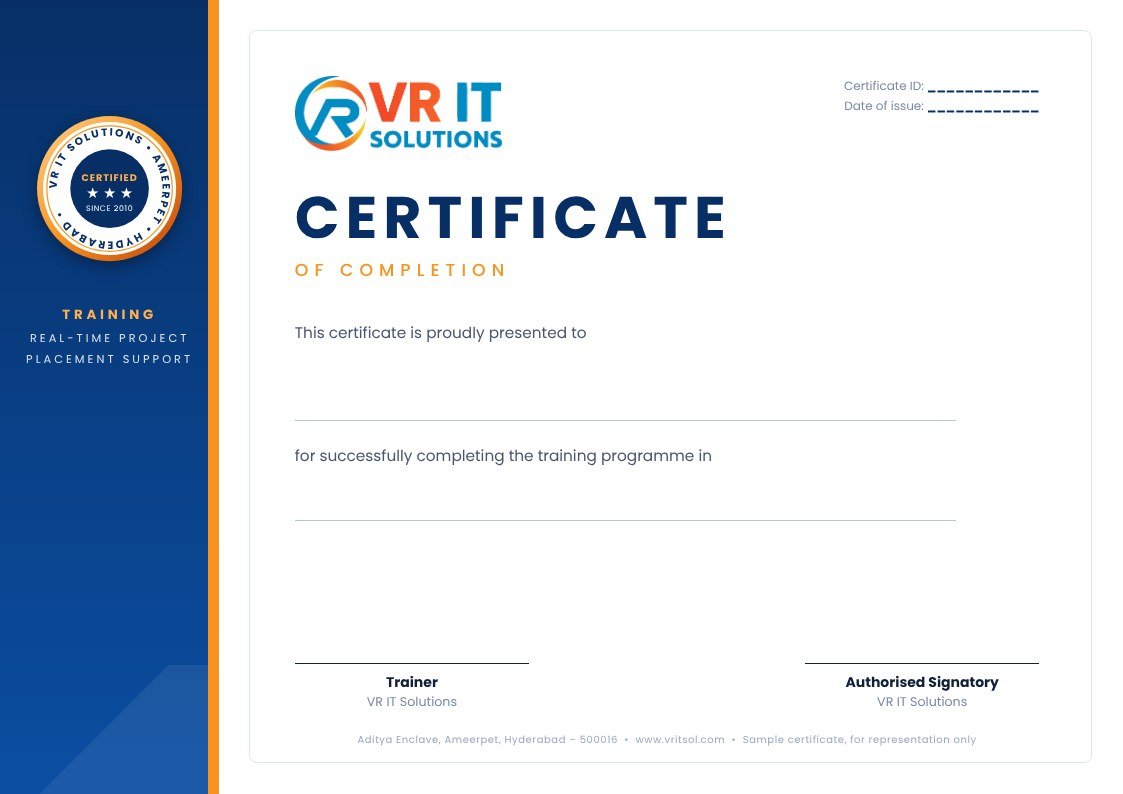
Get your course completion certificate
- Issued by VR IT Solutions when you complete the course and the real-time project
- Every certificate has its own certificate ID
- Add it to your resume and LinkedIn profile
Machine Learning Online Training in USA, UK & Canada
Looking for Machine Learning online training from the USA, UK or Canada? Join our live online batches from anywhere — classes run in time slots that suit your time zone, every session is recorded for revision, and you get the same real-time project, certificate and placement support as our Hyderabad students.
- USAEST & PST evening slots
- UKGMT / BST slots
- CanadaEST & CST slots
- WeekendSat & Sun, all time zones
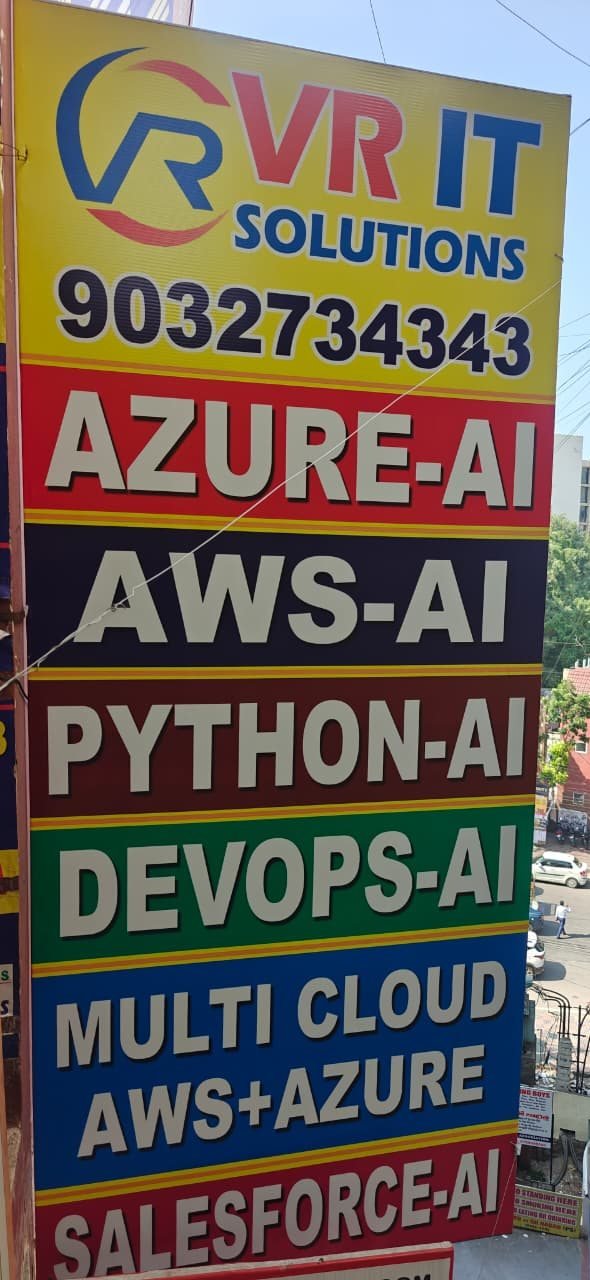
Visit our Ameerpet centre
- 506/A, Aditya Enclave, Nilagiri Block, 5th Floor, Ameerpet, Hyderabad – 500016
- Monday to Saturday, 9 AM – 7 PM
- +91 90327 34343
- info@vritsol.com
Machine Learning Training FAQs | VR IT Solutions
Machine Learning is a branch of AI that enables systems to learn patterns from data and make intelligent predictions without being explicitly programmed. It powers everything from fraud detection and medical diagnosis to product recommendations and autonomous vehicles, making ML engineers some of the most highly compensated professionals in the industry today.
You will learn Python for ML, NumPy, Pandas, Matplotlib, Scikit-learn, Supervised and Unsupervised Learning algorithms, Deep Learning basics, NLP, TensorFlow, and Model Deployment. All topics are taught through real-world projects that demonstrate how ML is applied in actual business contexts.
A basic understanding of statistics helps but is not mandatory. Our trainers explain all mathematical concepts in a practical, application-first manner so that students without a strong maths background can follow along and still build strong ML skills.
The training is completed in 45 to 60 days. Morning, evening, and weekend batches are available for both freshers and working professionals who want to transition into ML roles.
Valuable certifications include Google Professional Machine Learning Engineer, IBM Machine Learning Professional Certificate, and Microsoft Azure AI Engineer Associate. Our trainers guide you on which certification aligns best with your career goals and provide structured preparation support.
Entry-level ML engineers typically earn between 6 and 14 LPA in India. With 3 to 5 years of hands-on experience building and deploying ML models, professionals commonly earn 20 to 45 LPA in product companies and research-focused organizations.
Absolutely. VR IT Solutions offers free demo sessions for all courses. You can attend a live class, interact with the trainer, and get a feel for the training quality before making any commitment. Just reach out to our team and we will schedule one for you.
We provide end-to-end placement assistance — from building a job-ready resume to conducting mock interviews with industry experts. Our team actively shares job openings, refers students to hiring companies, and supports you until you land your first role.
Yes. Every trainer at VR IT Solutions has between 8 and 13 years of hands-on industry experience. They have worked on real enterprise projects and bring that practical knowledge directly into the classroom, which makes a significant difference when you face real job interviews.
Course Training
Industry-certified · Real-time projects · 100% Placement Support
Call us: +91-9032734343